



Powering a wedding or event: a practical generator checklist
A practical guide to powering a wedding or event in Kuwait, from calculating capacity and placing the generator to cabling, distribution, fuel and keeping noise down.
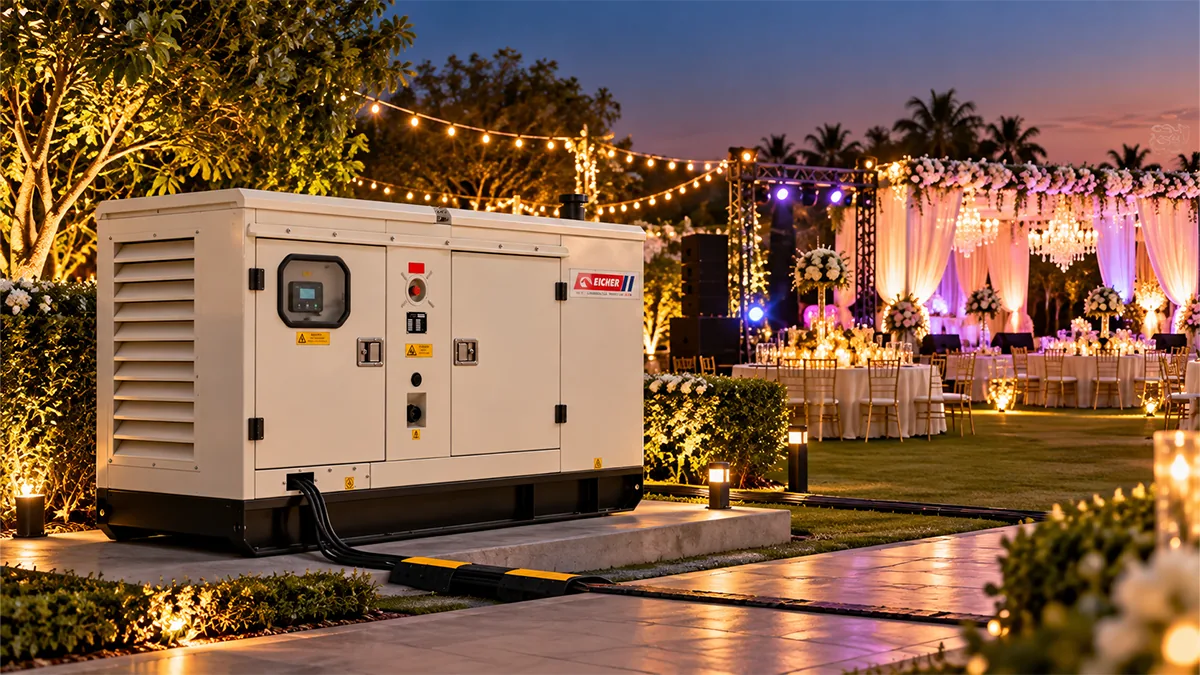
To power a wedding or event, add up lighting, sound, air conditioning and catering loads in kW, add a 20% to 25% margin, and choose a sound-attenuated generator placed 20 to 30 metres from guests. Use cables sized for current and distance, a distribution board with earth leakage protection, and enough fuel for the whole event plus reserve.
How much generator capacity does a wedding or event need?
Capacity is set by the actual loads, and in Kuwait the largest is usually air conditioning. Work out each load in kW and add them together, which gives you the starting point for choosing a generator.
The values below are approximate and for illustration only. Exact figures should come from the equipment rating plates or from your lighting, sound and air conditioning suppliers:
| Load | Approximate demand | Note |
|---|---|---|
| LED lighting for a hall or tent | 2 to 6 kW | Depends on area and number of fittings |
| Stage lighting and effects | 5 to 20 kW | Higher for large productions |
| Sound system | 2 to 10 kW | Needs a stable voltage |
| Portable air conditioning unit, 5 tons of refrigeration | 6 to 8 kW per unit | High starting current |
| Food warmers and catering equipment | 2 to 3 kW per appliance | Run for hours at a time |
For example, a tent with four 5-ton air conditioning units (about 28 kW), general lighting of 6 kW, stage lighting of 10 kW, a 5 kW sound system and four food warmers (about 10 kW) totals around 59 kW, or roughly 74 kVA at a 0.8 power factor.
Why do you need a margin above the total load?
Because air conditioning compressors and motors draw a starting current several times their running current for a few seconds. Without enough margin the voltage dips, lights flicker or go out, and the sound can cut at a critical moment.
Add 20% to 25% to the total, and allow for heat if the event is in summer, since available generator output falls in high temperatures. In the example above the requirement becomes about 90 kVA, so a 100 kVA generator is a comfortable choice.
Where should the generator go, and how far from guests?
Place the generator 20 to 30 metres from the guest area where possible, and on the side where the wind carries exhaust away from the tent and entrances. Distance is the simplest way to reduce noise.
Choose a sound-attenuated generator with an acoustic canopy. These units typically produce 65 to 75 dB(A) at 7 metres depending on size and model, and in open space the sound level falls by about 6 dB(A) each time the distance doubles. A set producing 70 dB(A) at 7 metres therefore drops to about 58 dB(A) at 28 metres, close to the level of normal conversation.
- Firm, level ground away from vehicle routes and children’s play areas.
- Clear space around the set for ventilation and fuel truck access.
- A simple barrier or fence to keep guests at a distance.
- Never place the generator inside the tent or in any enclosed space, because of the risk of carbon monoxide.
What cabling and distribution do you need?
Cables are sized for both current and run length, not current alone. The longer the distance between generator and tent, the greater the voltage drop, and the usual target is no more than 3% to 5% at the equipment.
- A 100 kVA generator at 415 V three-phase delivers around 139 A at full load, and cable size is selected on that basis together with the run length.
- A sub-distribution board near the tent with separate breakers for air conditioning, lighting, sound and catering.
- Earth leakage protection (RCD) rated at 30 mA on circuits that people can reach.
- Earthing of the generator with an earth rod in line with safety requirements.
- Cable protectors across walkways to prevent trips and damage.
How much fuel will the generator need for a full night?
A diesel generator typically uses about 0.3 litres per kWh at moderate loads, and more per kWh as the load falls, with the exact figure given in the manufacturer’s data for each model.
In the example above, an average load of around 45 kW for 8 hours equals about 360 kWh, or roughly 110 to 120 litres. Plan fuel for the whole event with a reserve of at least 25%, and avoid refuelling at the height of the celebration. For more detail, see generator fuel consumption.
What is the final checklist before the big day?
Run through these seven points at least a day before the event. Together they cover everything above:
- A complete load list in kW, including the margin.
- Generator position agreed and measured from the guest area, with wind direction in mind.
- Cable lengths and sizes calculated and prepared.
- Distribution board and protection devices installed and tested.
- Fuel quantity calculated with reserve.
- A full test run on the actual loads before guests arrive.
- An emergency contact number available throughout the event.
Alemtiaz rents generators for weddings, parties and events on daily and weekly terms, with delivery, installation and commissioning within 24 hours anywhere in Kuwait and emergency support within 24 hours. Send us your event details, loads and location, and request a quote through our generator rental page, or explore our events and occasions solutions.
Frequently asked questions
For smaller events, one correctly sized generator is usually sufficient. For large events, or any occasion that cannot tolerate an interruption, split the loads across two sets or keep a standby unit ready to take over.
Book early during the wedding and events season, so the right capacity is available and there is time to survey the site and agree the generator position and cable routes before the day.
A generator with an automatic voltage regulator supplies a stable voltage suitable for audio equipment. It is best to give the sound system its own circuit, separate from air conditioning, so compressor starting currents do not affect it.
Small gatherings that only need lighting and sound are usually covered by 20 to 40 kVA, and the requirement rises sharply once air conditioning units are added. Work out the loads first, then choose the capacity.
Fast reply
Get a quote within an hour
Tell us what you need and we will reply with a clear quote during working hours.
- A reply within an hour during working hours, Saturday to Thursday
- A clear quote that covers delivery, installation and commissioning
- Our technical team helps you choose the right capacity