



Generator derating in Kuwait's summer heat explained
A clear explanation of why diesel generator output falls in summer heat, how much is lost at 45, 50 and 55 °C, and how to size correctly for Kuwait.
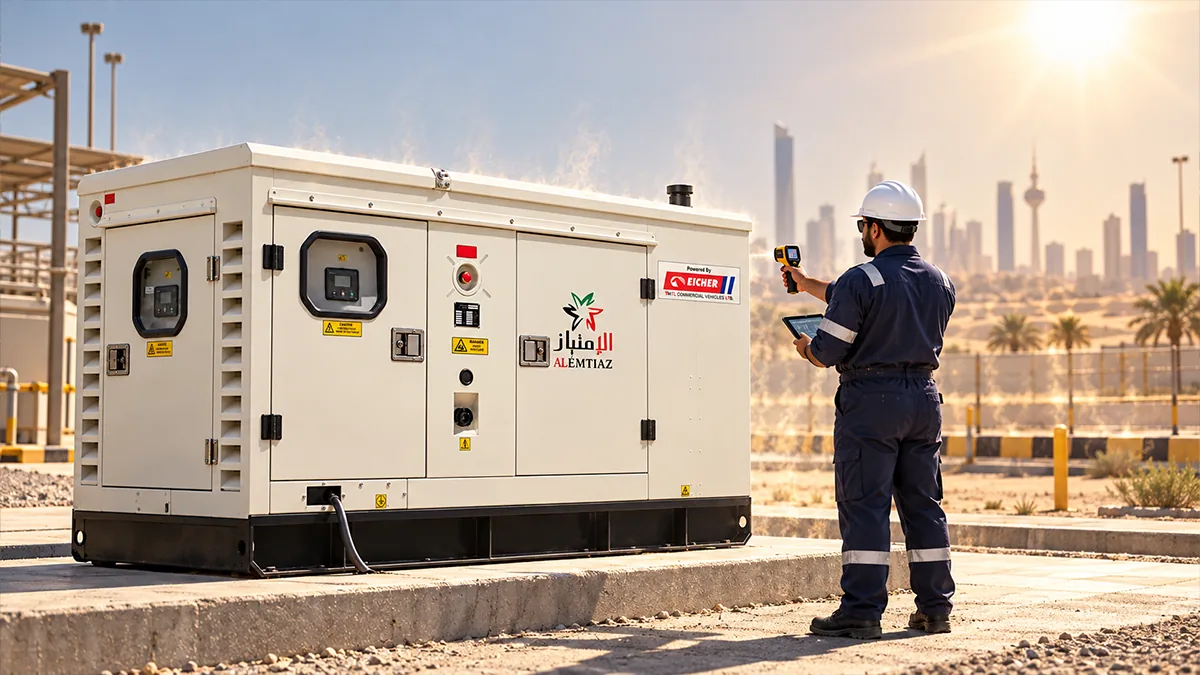
Generator output falls in summer because hot air is less dense and carries less oxygen for combustion, while the cooling system and alternator lose part of their ability to shed heat. Most sets are rated at reference conditions of about 25 °C and many keep full output up to 40 °C or more. Above that, the available output drops according to the manufacturer's derating curve, so size for site temperature.
What does derating mean for a generator?
Derating is the reduction of the load a generator may safely carry when operating conditions are harsher than the reference conditions at which it was rated. The figure on the nameplate, such as 500 kVA, only holds within certain limits of temperature, altitude and humidity.
Diesel generator ratings are usually stated under ISO 8528 and ISO 3046 at reference conditions of around 25 °C, 100 kPa barometric pressure and 30% relative humidity. Many manufacturers also publish the highest ambient temperature at which the set keeps its full output, often between 40 and 50 °C depending on the model and cooling package.
Why does high temperature reduce generator output?
Because heat weakens the engine, the cooling system and the alternator at the same time, so the unit cannot deliver full output without running above its safe temperature limits.
- Air density: hot air is lighter, so the engine draws in less oxygen on each cycle and can burn less fuel efficiently.
- Cooling system: the radiator depends on the difference between coolant temperature and air temperature. The hotter the air, the smaller that difference and the weaker the cooling.
- Alternator: the windings are designed for a set temperature rise above ambient. When the surroundings are already hot, current must be reduced to protect the insulation.
- Actual intake air: air entering a generator inside a plant room or acoustic enclosure can be several degrees hotter than the outside air, especially if hot radiator discharge air recirculates to the intake.
How much output is lost at 45, 50 and 55 °C?
The loss depends on the engine and cooling package, but it usually starts small and grows with every further rise in temperature. The table below is an illustrative example only, for a set rated at 500 kVA up to 40 °C, assuming a 3% reduction for every 5 °C above that.
| Air temperature at generator intake | Available output | Approximate available capacity |
|---|---|---|
| 40 °C | 100% | 500 kVA |
| 45 °C | 97% | 485 kVA |
| 50 °C | 94% | 470 kVA |
| 55 °C | 91% | 455 kVA |
Actual values come from the manufacturer’s derating curve for each model. Sets rated only at 25 °C can lose noticeably more on peak days, while models fitted with high-ambient radiators hold their output to higher temperatures.
How do you size a generator for a Kuwaiti summer?
Size for the worst summer day, not for reference conditions. A practical method has three steps:
- Calculate the real load in kW and convert it to kVA using the power factor, commonly 0.8. For more detail, see kVA vs kW explained.
- Add a margin of 20% to 25% for motor starting currents and future growth, so the set does not run continuously above 80% of its capacity.
- Apply the derating factor for the expected site temperature, which can reach 50 °C or more at the height of summer, then choose the model that covers the result.
For example, a real load of 320 kW equals 400 kVA at a 0.8 power factor, and a 20% margin brings the requirement to 480 kVA. If the candidate model drops to 94% at 50 °C, a 500 kVA set delivers only about 470 kVA, so the next size up is the safe choice.
What are the signs a generator is overloaded in the heat?
The clearest signs are rising coolant temperature, black smoke and unstable frequency. If you see any of them during the midday hours, the set is most likely running close to its limit.
- A high engine temperature alarm, or automatic shutdown at peak hours.
- Black smoke from the exhaust as the load increases.
- Frequency dropping below 50 Hz, or voltage dips when air conditioners and pumps start.
- The main breaker tripping repeatedly with no obvious fault in the connected loads.
These signs call for a technical inspection, because the cause may be a dirty radiator or a blocked air filter rather than undersizing alone.
How can you reduce the effect of heat on site?
Better ventilation and cleanliness recover a meaningful share of output without replacing the generator.
- Place the set in shade or under an open-sided canopy, away from walls that reflect heat.
- Leave enough clearance in front of and behind the radiator, and prevent hot air from recirculating to the intake.
- Clean the radiator and air filter regularly during the dust season.
- Start large loads such as air conditioning in stages rather than all at once.
If you are unsure whether your current generator will cope with the summer, or you are planning a new purchase, send us your load details and site location and we will recommend a capacity suited to Kuwait’s heat. Request a quote through our generators for sale page, and for a pre-summer inspection and clean, visit our generator maintenance page.
Frequently asked questions
Only marginally, as most of Kuwait sits close to sea level. The factors that matter most locally are high temperature and dust, and these are what should drive generator sizing.
Humidity has a smaller effect on output than heat, although it grows when high temperature and high humidity combine. In coastal areas humidity also speeds up corrosion, so metal and electrical parts need more regular inspection.
Yes. Cooler night-time air lets the set run closer to its rated output. Sizing should still be based on the hottest daytime conditions, because loads such as air conditioning peak at the same time.
Yes, the same principle applies to rental units. When requesting a quote, describe the loads, where the set will be placed and when it will be used, so the supplier can recommend a capacity suited to site temperature.
Fast reply
Get a quote within an hour
Tell us what you need and we will reply with a clear quote during working hours.
- A reply within an hour during working hours, Saturday to Thursday
- A clear quote that covers delivery, installation and commissioning
- Our technical team helps you choose the right capacity