



Generator sizing for a chalet or desert camp in Kuwait
How to choose the right generator capacity for a winter desert camp or summer chalet in Kuwait, with indicative ratings, noise levels and expected daily diesel use.
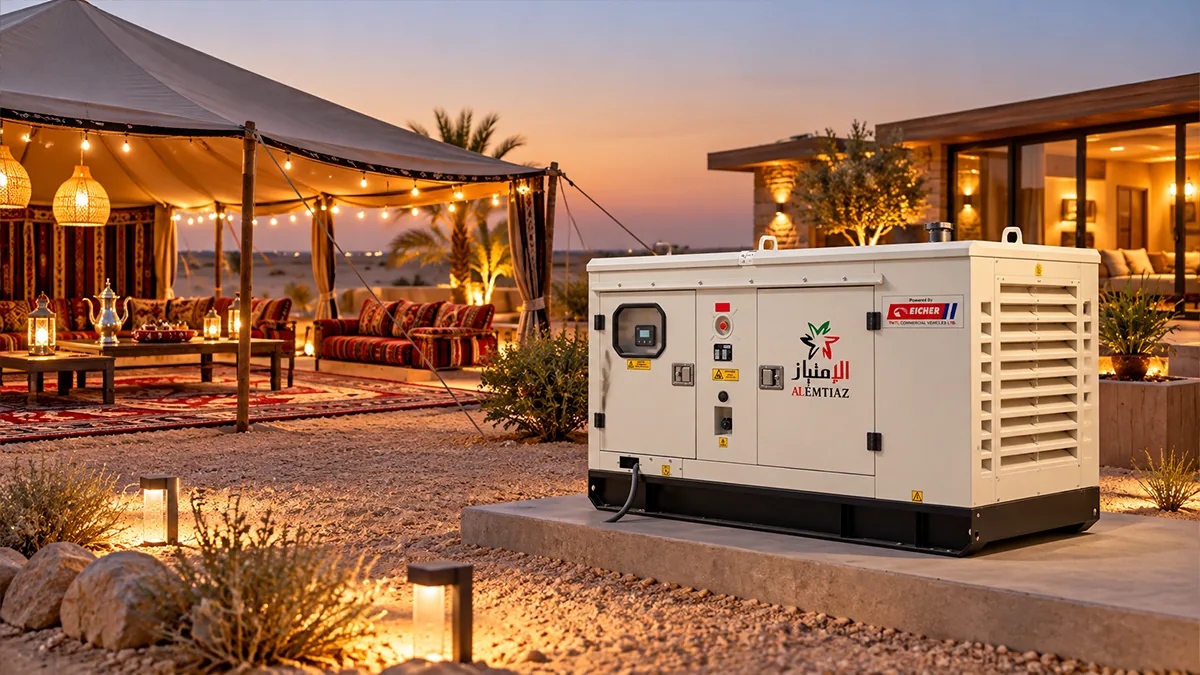
A typical family desert camp in Kuwait needs a generator of 20 to 30 kVA to run lighting, heaters, a refrigerator and light appliances, rising to 40 kVA or more once air conditioners are added. A chalet in summer usually needs 30 to 150 kVA depending on the number and type of air conditioners and whether it has a pool. The exact rating is set once the loads are surveyed.
Does a chalet need a different generator from a camp?
Yes. A winter desert camp usually needs less capacity because its loads are lighting, heating and light appliances, while a summer chalet needs far more because air conditioning runs for most of the day. There is no single answer to the question of how many kilowatts you need; the right answer starts with the type of site and the season.
Whatever you call it on site, the figures that matter are the same: the rating in kVA, the type of generator, its noise level and the size of its fuel tank.
How do you estimate the load of a winter camp?
Add up the appliances that will run at the same time in the evening, because demand in a camp peaks after sunset. Here is a typical family camp:
- Three electric heaters at 2 kW each: 6 kW.
- Kettle and hospitality appliances: 2 kW.
- Indoor and outdoor LED lighting: 1 kW.
- Refrigerator, television and chargers: 1.5 kW.
The total is about 10.5 kW. Adding a 25 percent margin brings it to roughly 13 kW, or about 16 kVA at a power factor of 0.8, so a 20 kVA generator is the right fit. Adding a split air conditioner or an air conditioned caravan raises the requirement noticeably, because of both the running load and the compressor’s starting current.
What capacity suits each type of site?
The table below gives indicative ranges to start the conversation; the exact rating is set once the actual appliances and the starting current of air conditioners and pumps are known.
| Type of site | Typical loads | Indicative rating (kVA) |
|---|---|---|
| Small camp | Lighting and light appliances | 10 to 15 |
| Family camp | Heaters, kettle, refrigerator, television | 20 to 30 |
| Large camp or camp with caravans | Split AC units, heaters, kitchen | 40 to 60 |
| Small chalet | Split AC units, lighting, kitchen | 30 to 60 |
| Large chalet | Central AC, pool pumps, water heaters | 80 to 150 |
How much power does a chalet need in summer?
A chalet in summer typically needs two to three times the capacity of a winter camp or more, because air conditioning makes up most of the load and runs for long hours in extreme heat.
On top of that come pool pumps and filtration, water heaters, the kitchen and outdoor lighting. High temperatures also reduce a generator’s real output, so a chalet generator should not run above 80 percent of its rated capacity for long periods, and it should sit in a shaded, well ventilated spot away from the bedrooms.
Why does noise matter, and what does a silent canopy do?
Noise decides how comfortable a camp or chalet is for sitting and sleeping. A generator fitted with a sound attenuated canopy is markedly quieter than an open frame unit.
| Source | Typical noise level at 7 metres (dB(A)) |
|---|---|
| Open frame diesel generator | 85 to 100 |
| Diesel generator with sound attenuated canopy | 65 to 75 |
| Normal conversation, for comparison | About 60 |
Every increase of around 10 dB(A) is perceived as roughly a doubling of loudness, so the difference between an open unit and a canopied one is significant in practice. Placing the generator at a sensible distance from seating and sleeping areas, with the exhaust pointing away from tents and downwind, helps further.
How much diesel does a camp use per day?
A 20 kVA generator running at half load typically uses about 3 litres per hour, or roughly 70 to 80 litres over 24 hours of continuous operation. The exact figure depends on the engine and the real load; you will find a detailed table in our guide to diesel generator fuel consumption.
At remote sites, agree on fuel supply in advance and make sure the tank holds enough for at least a full night without refilling, with a reserve of diesel kept in approved containers away from the generator, heat sources and open flames.
Is renting better than buying for a chalet or camp?
For seasonal use, renting is usually the more economical option: you pay only for the period you need, without storage and maintenance costs throughout the year. Alemtiaz rents generators by the day, week, month and year, with delivery, installation and commissioning within 24 hours anywhere in Kuwait. To learn more about how we serve these sites, visit our chalets and camps solutions page.
Tell us where your camp or chalet is and what will be running, and we will recommend the right capacity and send a quotation within an hour during working hours. Request yours from our generator rental page.
Frequently asked questions
It can if the unit is included in the sizing. A 1.5 ton split unit typically draws about 2 kW when running and several times that at start up, which noticeably raises the capacity the camp needs.
Yes. The generator must be earthed with a suitable earth rod to protect people from electric shock, especially given sandy ground and night time humidity in the desert.
Run the generator in the open at a safe distance from tents, with the exhaust pointing away from them and downwind. Exhaust gases contain carbon monoxide, so a generator must never run inside a tent or enclosed space.
Yes. Monthly rental suits a full camping season, and daily and weekly rental is available for short trips and occasions.
Fast reply
Get a quote within an hour
Tell us what you need and we will reply with a clear quote during working hours.
- A reply within an hour during working hours, Saturday to Thursday
- A clear quote that covers delivery, installation and commissioning
- Our technical team helps you choose the right capacity