



What size generator do I need for my house in Kuwait?
A practical guide to sizing a home generator in Kuwait in kVA, from listing your appliances and starting current to safety margins and choosing the nearest standard rating.
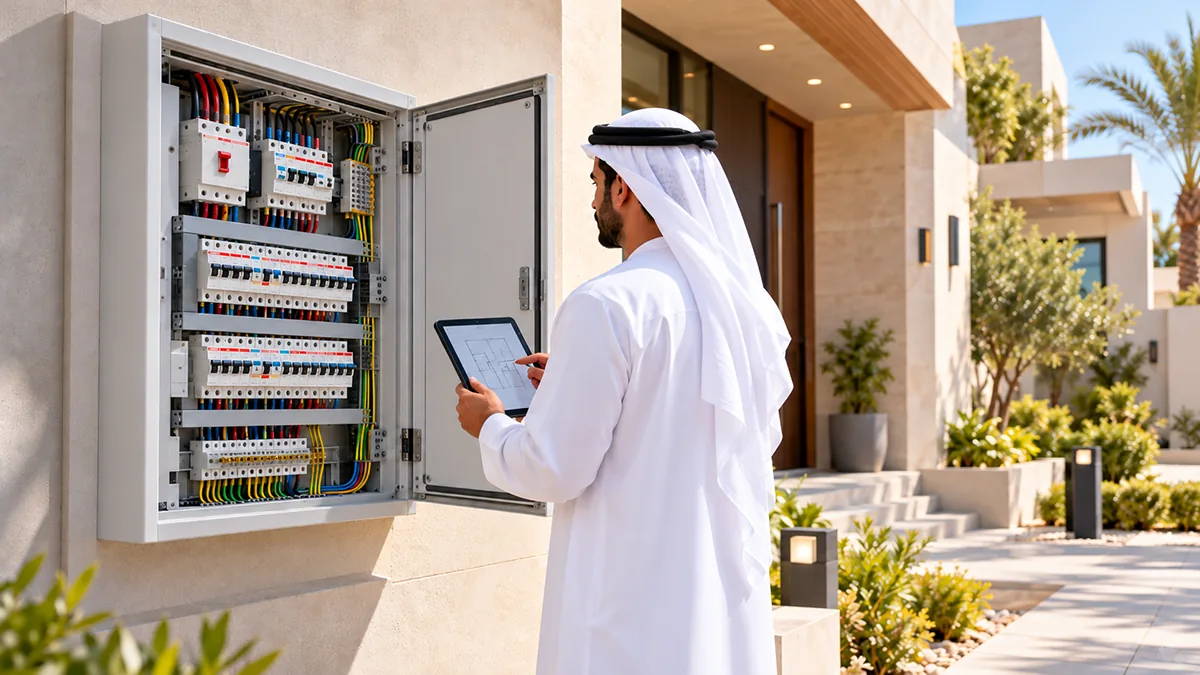
To size a house generator, add the running power in kW of every appliance that will operate together, add the extra starting demand of the largest motor load such as an air conditioner, then add a 20 to 25 percent margin. Divide by a power factor of 0.8 to get kVA and choose the next standard rating up.
Why isn’t floor area enough to size a generator?
Because a generator is sized by the loads it must carry at the same moment, not by square metres. Two houses of the same size can need very different capacity depending on how many air conditioners they have, the type of units installed, and whether they run electric water heaters, pumps or a home lift.
Correct sizing therefore starts with an inventory of the actual appliances and a decision on which of them must keep running during an outage. Estimates based on floor area alone usually lead to one of two mistakes: a generator that is too small and trips when the air conditioning starts, or one that is too large, runs at light load, burns more fuel than necessary and builds up carbon deposits in the engine.
Which appliances should you list before choosing a generator?
List every appliance with a meaningful power draw and record its running power in kW from the rating plate. The table below shows typical values for Kuwaiti homes; exact figures vary with model, age and efficiency.
| Appliance | Typical running power (kW) | Starting current vs running current |
|---|---|---|
| Split AC, 1.5 ton | 1.8 to 2.2 | 3 to 5 times |
| Split AC, 2.5 ton | 3 to 3.5 | 3 to 5 times |
| Central AC unit, 5 ton | 6 to 7.5 | 3 to 6 times |
| Electric water heater | 2 to 3 | No extra starting current |
| Domestic water pump | 0.75 to 1.5 | 3 to 5 times |
| Large refrigerator | 0.2 to 0.5 | 3 to 4 times |
| Washing machine | 0.5 to 2 | 2 to 3 times |
| LED lighting, whole house | 1 to 2 | No extra starting current |
Air conditioning is the largest load in most Kuwaiti homes, so each unit deserves its own line with its tonnage.
How does starting current affect generator size?
Starting current is the main reason a generator must be larger than the sum of the running loads. Appliances with a motor or compressor, such as air conditioners, pumps and refrigerators, draw several times their normal current for a few seconds when they start.
If this surge is not allowed for, the voltage can dip the moment an air conditioner starts, the lights flicker or the generator protection trips. The practical solution is to add the extra starting demand of the single largest motor load to the total, and to start air conditioners in sequence rather than all at once. Modern transfer panels do this with a short time delay between loads.
How does the calculation work in practice?
The calculation takes five clear steps. Take a villa with six 2 ton split units, two water heaters, a water pump and normal kitchen and lighting loads:
- Total running load: air conditioners about 15 kW, water heaters 6 kW, pump 1.5 kW, kitchen 4 kW, lighting and other appliances 5 kW, giving roughly 31.5 kW.
- Starting allowance for the largest load: a 2.5 kW air conditioner starting at three times its running current adds about 5 kW, bringing the total to 36.5 kW.
- Safety margin: adding 25 percent for future additions and high ambient temperature lifts the figure to about 46 kW.
- Convert to kVA: dividing 46 by a power factor of 0.8 gives about 57 kVA.
- Choose a standard rating: the nearest available rating above the result is 60 kVA.
For a closer look at how the two units relate, read our guide to kVA, kW and power factor.
Should you back up the whole house or only essential loads?
If you want daily life to continue unchanged during an outage, a generator that covers the whole house is the right choice. If the aim is to protect the essentials, a smaller generator feeding a separate essential circuit is enough.
Essential loads usually include one or two air conditioned rooms, refrigerators, the water pump, lighting, and communication and internet equipment. This option reduces generator size and fuel cost, but the circuits must be separated in the distribution board by a qualified electrician, with a transfer switch that prevents generator power from feeding back into the public grid.
What changes in a Kuwaiti summer?
High temperatures and dust reduce a generator’s real output, so home generators in Kuwait need a larger margin. Manufacturers rate their generators at a reference ambient temperature, and above that point the available output falls according to each engine’s derating tables.
We recommend installing the generator in a well ventilated, shaded position, cleaning air filters regularly, and avoiding long periods above 80 percent of rated output during the summer months.
Is a new or used generator right for you?
A new generator suits owners who want the longest service life, while an inspected used unit is a sound economical choice for homes that need standby power for limited hours. Alemtiaz supplies new diesel generators from brands including Eicher and Cooper, as well as used generators with low running hours, regular servicing and warranty on all parts.
Would you like an exact calculation for your home? Send us your appliance list or ask for a site visit, and you will receive a quotation within an hour during working hours, Saturday to Thursday. Request your quote from our generators for sale page.
Frequently asked questions
Yes, provided the central units and the starting current of their compressors are included in the sizing. Starting the units in sequence also reduces the peak demand on the generator.
Most villas in Kuwait are supplied with three phase power at 415 volts, so a three phase generator is the usual choice, with loads balanced as evenly as possible across the three phases.
It switches the house to the generator automatically when mains power fails and back to the grid when it returns, while preventing generator power from reaching the grid to protect technicians and the generator.
Outdoors in a well ventilated spot away from windows and air intakes, on a level base, with the exhaust directed away from the house and enough clearance around the unit for maintenance.
Fast reply
Get a quote within an hour
Tell us what you need and we will reply with a clear quote during working hours.
- A reply within an hour during working hours, Saturday to Thursday
- A clear quote that covers delivery, installation and commissioning
- Our technical team helps you choose the right capacity