



Diesel generator maintenance schedule: daily, 250 hours, 500 hours and yearly
A practical guide to a diesel generator service schedule, from daily checks to the annual overhaul, with what changes in Kuwait's heat and dust and how to prevent breakdowns.
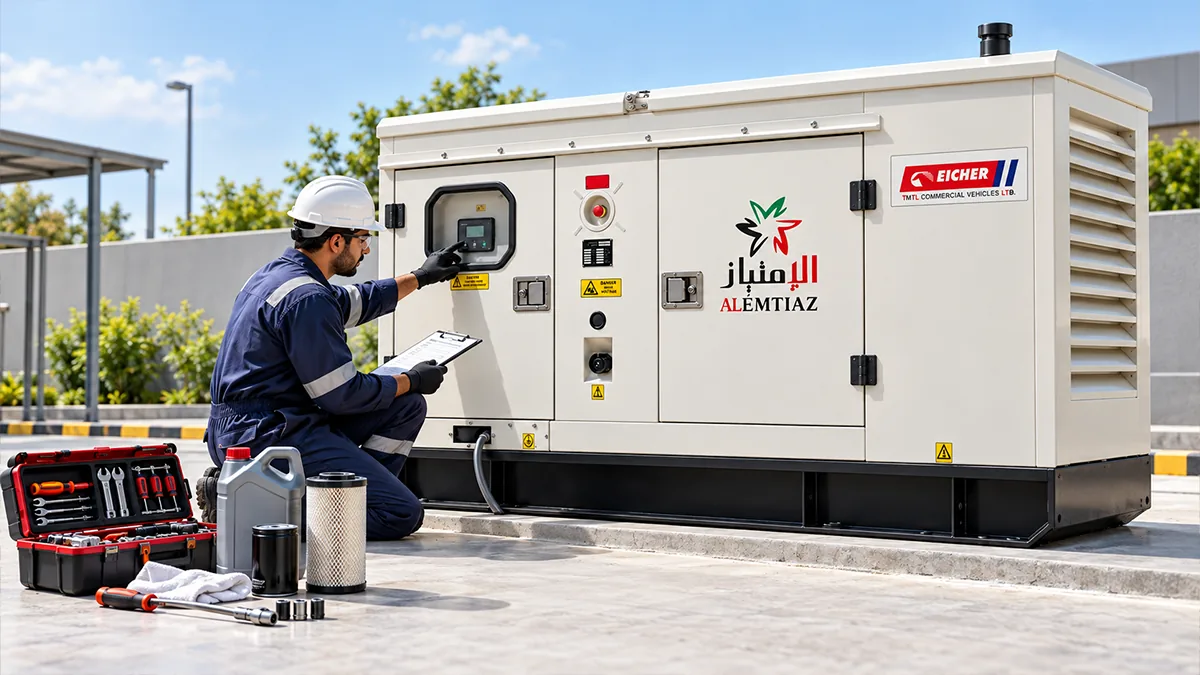
A diesel generator needs a quick daily check of oil, coolant, fuel, leaks and battery; an oil and oil filter change at around every 250 hours; fuel and air filter replacement at around 500 hours; and a full annual service with a load test. Exact intervals depend on the manufacturer's manual and operating conditions.
Why does a diesel generator need a fixed maintenance schedule?
Because most generator failures start with small, detectable problems such as low coolant, a blocked air filter or a weak battery. A fixed schedule turns maintenance from a reaction after a breakdown into planned work that protects the engine and extends its life.
Whether the unit is a standby generator for a building or a prime power set running around the clock on a construction site, sticking to the intervals is what ensures it performs when needed. Intervals are normally counted in running hours or calendar time, whichever comes first.
What should be checked every day before starting?
The daily check usually takes no more than 10 to 15 minutes and catches most problems before they become failures. The site operator carries it out from a fixed list:
- Engine oil level on the dipstick, between the minimum and maximum marks.
- Coolant level in the expansion tank, checked only when the engine is cold.
- Fuel level in the tank, and draining water from the water separator where fitted.
- No oil, fuel or coolant leaks beneath the set.
- The air filter restriction indicator.
- Belt condition and tension, and a clean radiator core.
- Battery voltage and clean terminals.
- No stored alarms on the control panel.
What is done at every 250 running hours?
At 250 hours, or every 6 months for units that run little, the engine oil and oil filter are typically changed and the supporting systems inspected. Some engines allow longer intervals, so always refer to the manufacturer’s manual.
- Change the engine oil to the recommended grade and replace the oil filter.
- Clean or inspect the air filter, and replace it if it has reached the restriction limit.
- Check coolant concentration and protection level.
- Check belt tension and the condition of hoses and connections.
- Test the battery with a load tester and charge it if needed.
- Inspect electrical connections in the control panel and at the alternator terminals.
What is added at 500 running hours?
At 500 hours, tasks focused on the fuel and air systems are added to the previous list, as these are the systems most affected by fuel quality and site dust.
- Replace the primary and main fuel filters and the water separator element.
- Replace the air filter element.
- Drain sediment and water from the bottom of the fuel tank where required.
- Inspect the exhaust system for leaks and cracks.
- Check the voltage regulator and review voltage and frequency readings under load.
Which annual service tasks should never be postponed?
The annual service is a full inspection of the engine and alternator, and it must include a genuine load test. It is the only real opportunity to confirm that the generator delivers its rated output rather than simply turning over.
- A load bank test, typically lasting at least two hours, recording temperatures, pressures, voltage and frequency.
- Cleaning the radiator inside and out, and replacing the coolant every two years or as the manual specifies.
- Measuring the insulation resistance of the alternator windings.
- Inspecting engine mounts and fixings.
- Testing the automatic transfer switch (ATS) on standby installations.
- Reviewing valve clearances and injector condition according to accumulated running hours.
What does the full schedule look like at a glance?
The table below summarises typical intervals. These are common values for diesel engines, while the exact intervals are set by the manufacturer according to the engine and the type of load.
| Interval | Main tasks | Carried out by |
|---|---|---|
| Daily or before each start | Oil, coolant, fuel, leaks, battery, alarms | Operator |
| Weekly for standby units | Test run of 15 to 30 minutes, preferably on load | Operator |
| Every 250 hours or 6 months | Oil and oil filter change, air filter, belts and battery checks | Technician |
| Every 500 hours | Fuel filters and water separator, air filter element, exhaust system | Technician |
| Yearly | Load test, radiator and coolant, winding insulation, ATS | Specialist technician |
Does maintenance differ in Kuwait’s heat and dust?
Yes. Harsh conditions shorten the effective intervals. Summer temperatures above 45 °C put extra strain on the cooling system, while dust and sandstorms clog air filters and radiator cores faster than usual.
In summer it is therefore wise to check the air filter after every dust storm, blow out the radiator with compressed air more often, and watch engine temperature under load during the midday hours. To understand how heat reduces available output, read why generator output drops in Kuwait’s summer.
What does a rarely used standby generator need?
A generator that stands idle for long periods needs time-based maintenance rather than hour-based maintenance. Oil oxidises, batteries discharge and stored fuel picks up contamination and moisture even when the engine does not run.
Running it weekly, changing the oil at least once a year and checking the battery and fuel quality ensure it starts immediately when the mains supply fails.
If you would rather have a specialist team manage this schedule for you, Alemtiaz offers planned maintenance contracts and emergency support within 24 hours, with a mobile workshop that comes to your site and spare parts for Perkins, Cummins, Caterpillar and Kirloskar engines. Request a quote through our generator maintenance page or order parts from our generator spare parts page.
Frequently asked questions
No. Use a diesel engine oil with the specification and viscosity grade stated in the manufacturer's manual. In Kuwait's hot climate, a viscosity suited to high temperatures plays an important part in protecting the engine.
A generator battery typically lasts two to three years, and high temperatures can shorten that. Regular testing with a load tester reveals a weakening battery before it fails to start the engine.
Preventive maintenance is planned work at fixed intervals to avoid failures, while emergency maintenance follows a breakdown to restore power as quickly as possible. Good preventive work reduces both the need for and the cost of emergency call-outs.
Usually, yes. Most warranties require the recommended service schedule to be followed and documented. Keep a log of the date, running hours and parts replaced at every visit.
Fast reply
Get a quote within an hour
Tell us what you need and we will reply with a clear quote during working hours.
- A reply within an hour during working hours, Saturday to Thursday
- A clear quote that covers delivery, installation and commissioning
- Our technical team helps you choose the right capacity